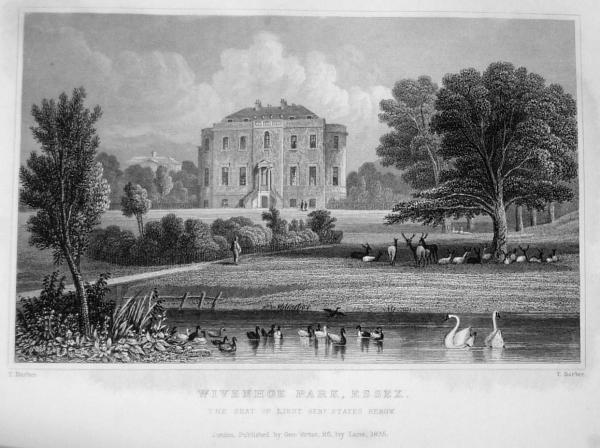
Start by looking at the Essex Past image of Wivenhoe Park. Find something to follow through the picture, such as the edge between trees and open ground. A short visit can have a clear focus if you start with one question about the landscape.
Read about the design before you choose a route
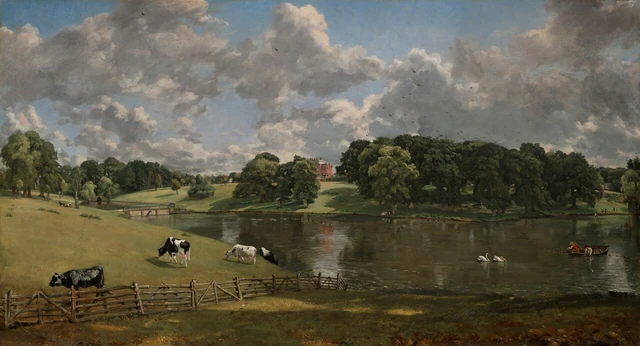
The University of Essex’s park history describes changes to the lakes and the stream between them. It also discusses the park as it appears in John Constable’s painting. Treat the university’s account and the archive engraving as two sources. Each gives a different way to investigate how the park’s water and views were shaped.
Find a suitable starting point
Check the university’s current visit information before travelling. Look for a viewpoint that fits your needs, considering the surface, slope and distance. You can turn a longer outing into a short visit by choosing a point to observe and a clear route back.
- Pick a feature to look for, such as the line of a bank or a group of trees.
- Note where you stood and which direction you faced.
- Record what the present view can show and what would need a historical map or further reading.
Take your observation back to the archive
Compare your note with the old image when you return. A similar feature can prompt a good question even if you cannot identify the original viewpoint. Keep the distinction between what you saw and what you inferred so a later visit can build on it.
Choose one view before you try to follow a route
Start with a feature you can describe without knowing its name. It might be a line of trees at the edge of the water, a bridge crossing a narrow section or the contrast between an open slope and a wooded bank. Write your description next to the title of the archive engraving. Give yourself one thing to look for on the visit. The whole park need not fit into the outing for the comparison to be worthwhile.
Look at the university’s current visitor information and see which part of the park you can reach comfortably. The access information for the Colchester campus is useful for checking arrival options and routes around campus. If the view you first picked requires more walking than you want, look for a different public viewpoint or plan the exercise with the images at home.
Follow the relationship between land and water
The university’s history describes work in the late eighteenth century to enlarge the lakes and connect them with a stream. That history gives you a specific question to investigate. Look at how water separates or joins different parts of the view. A bridge can serve a practical purpose and also draw attention to a place where the line of the bank changes. Note whether the view from your location makes those connections apparent.
Write carefully when you describe what you saw. “From this point I could see water beyond the trees” is an observation. “This is the viewpoint the artist used” is a much stronger claim. It would need evidence such as the outline of several stable features lining up or a record of where the view was made. Leaves, reflections and water levels can change the appearance of a place even if the viewpoint is the same.
Compare the engraving with a painting and your own view
John Constable’s Wivenhoe Park, Essex is available to examine through the National Gallery of Art. Keep that painting and the archive engraving open separately. For each one, locate the horizon, trace the main lines that lead your eye into the scene and notice what the artist places in the foreground. Then compare one of your observations from the visit. A modern photo, a painting and an engraving give you different ways to ask about the same landscape.
Suppose you notice that the bank appears almost straight from where you stand, while one of the historical views makes it curve strongly across the frame. Before deciding that the shoreline changed, consider the angle from which you are looking. From another public point, a curve can look less pronounced. Keep both possibilities in your notes. A dated landscape plan or a second view may help you tell them apart.
Make three notes you can use on another visit
- Place. Describe where you stopped, using a feature that is visible on a current map. Note the direction you were facing.
- Conditions. Record the time of year and anything that changed what you could see, such as glare, leaves or a temporary diversion.
- One open question. Write a question small enough to return to. For instance, ask whether the view of a bridge is clearer from another suitable point.
If you go with someone, try making independent notes about the same feature before comparing them. You might both notice the water and disagree about which tree line directs attention to it. That difference is useful. It can send you back to the artwork with a clearer reason to look again.
Adapt the outing to the day
A visit can be one short stretch with a place to turn back, a viewpoint reached by a route you already know, or a comparison done indoors. If weather or surface conditions make the original path unsuitable, keep the question and change the setting. On a later visit, use the same notes to compare the scene at a different time of year. The most helpful result is a description another person could use to see what you noticed.