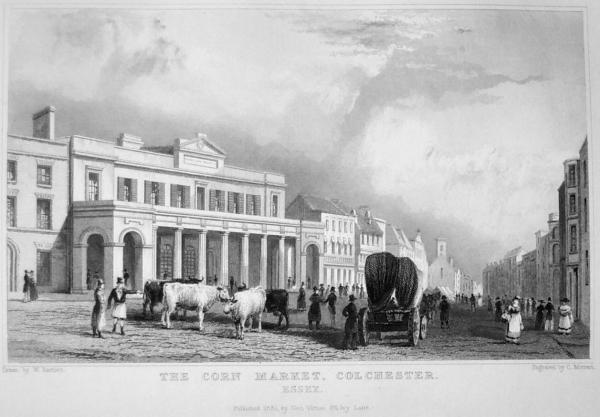
Two images of the same town can tell quite different stories. The Essex Past image collection includes views labelled Corn Market and High Street in Colchester. Start by looking at the clues the images give you, such as the street edge, the angle of the buildings and where people are placed.
Give each image its own viewpoint
Draw a rough sketch of the direction you think the artist looked. Keep the labels from the archive with your notes. Do the two works show the same kind of space? A wider view may describe the relationship between buildings and street, while a narrower one concentrates on a single feature.
Check a specific feature against a record
Historic England’s listing for Colchester Town Hall provides an example of a record that names one particular building and explains its history. When reading a listing, match the name and location before associating it with a feature in an engraving. Streets can contain several buildings from different periods.
- Write down the archive title for each view.
- Choose a feature you can describe in your own words.
- Use a map or heritage record to check whether the feature can be located today.
Keep the outing simple
If you visit, take a short route on current streets and make observations from a comfortable public stopping point. One detail is enough for a first comparison. When you return, write down which part fits the old view and leave any uncertain identification open for another visit.
Read the captions below the picture
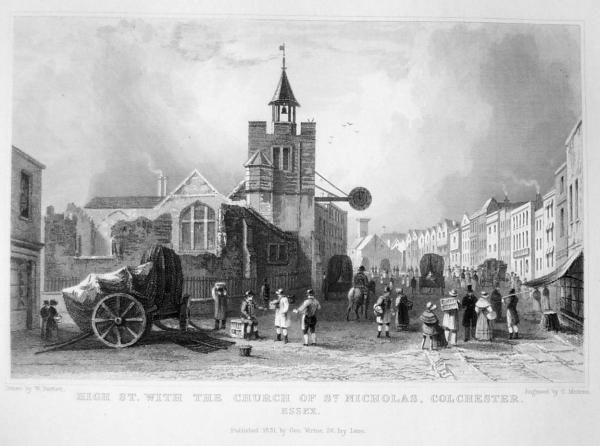
The margin of the High Street engraving names St Nicholas's Church. The Corn Market print identifies a different subject in its own margin. Those captions are part of the evidence. In a crop cut close around either scene, you can still see buildings and street activity, but you lose the words that make the strongest initial identification. When making a comparison, save the archive page title and the visible title below the print. The Images of Essex index attributes the prints to Thomas Wright's county history and gives 1831 as the publication date. Treat a date from the directory as a reference to the source it names and check a particular edition if that distinction matters for your work.
Jot down the question the caption helps answer. It anchors the church in the High Street view. It does not supply a name for every frontage or tell you what every passer-by was doing. That distinction leaves room to describe the composition and track additional clues independently.
Compare which objects each print puts in the foreground
The Corn Market view opens around a stately building with a columned frontage. Cattle stand in the foreground and a covered wagon occupies a prominent part of the street. In the High Street view a large cart wheel is conspicuous at the left, while the tower and the projecting clock dial draw your eye upwards. Try masking the crowd and vehicles with a sheet of paper. The architectural subjects are easier to compare. Remove it and see where people and animals make the street appear busy, wide, or deep.
These everyday details are evidence of how the image presents the town. They can suggest questions about circulation and work. A scene chosen for a published print gives no continuous record of how a street was used. Try comparing the relative position of fixed features first, then describe the cart, animals and figures as features of each composition. That keeps the visual analysis useful when there is no separate record of the particular scene.
Test the most tempting modern match against the dates
Look up the records for a building whose name resembles the print title. Historic England's official entry says the Albert Hall on High Street was built in 1845 as a Corn Exchange and substantially reconstructed in the twentieth century. Since the archive attributes the historic print to a source dating from 1831, matching the print to the surviving building simply because both references concern a corn market would overlook a chronological problem. The later listing is useful precisely because its dates give you something to test.
For the High Street plate, the Colchester Heritage Explorer entry on St Nicholas's Church records its demolition in 1955 and subsequent archaeological work on the site. A modern comparison can therefore look at the position of the site and the alignment of neighbouring streets. The Historic England local collection gives access to a later photograph of the church, which adds a stage between the print and a modern visit. Compare the date and angle before trying to line up the tower or street edges.
Finish with a comparison someone else could check
Make a small table in your notes with the image title, a visible detail and the record consulted. For the High Street image, add the caption's church name and the heritage record's account of demolition. For the Corn Market print, note the columned frontage and the date problem raised by the Albert Hall entry. Leave an open line for evidence about the exact viewpoint of each print.
On a visit, compare elements that can be seen from a public stopping point. Try a street corner or a line of sight between frontages. Afterwards, describe which relationships fit and which landmarks have changed. The comparison is worthwhile even when the precise spot where the artist looked remains uncertain.